


Husö Biological Station – Publications


Research reports from Husö Biological Station
The series is written in Swedish but from 1990 there is an abstract and an alternative title in English in each issue.
Forskningsrapport till Ålands landskapsstyrelse (1979 – 1989)
Rapporter från Husö biologiska station (1990 – )
Long-term data series
At Husö Biological Station, there are three long-term data stations: Husöviken, Ivarskär and Äppelö. Since the early to mid-1990s, these stations have been visited regularly during the summer (May-September). Sampling at the stations includes basic water parameters, thanks to the regular sampling intervals; it is possible to follow up changes at these stations over time.
We have since 2005 also had an automatic temperature meter at the jetty of Husö to measure the water temperature. In addition, since 2016, we have regularly monitored the oxygen and nutrient levels at the Ål Bergö station in the northern part of Ivarskärsfjärden during the summer.
The results from these time series indicates that the water has become warmer and that eutrophication is still a problem in our waters. In recent years, however, no major change in the parameters describing the status of eutrophication can be seen. Whether this is a trend that continues, remains to be seen.
Based on Husö’s long-term series, we can also conclude that the annual extreme conditions have become increasingly extreme, i.e. the cleft between the highest and lowest measured temperature during the summer increases towards more recent years while there are signs that would suggest the period these extremely warm periods occurs also gets longer with time.
The oxygen monitoring that has been carried out at the Ål Bergö station since 2016 shows that the oxygen situation in the water near the bottom is still bad during the late summer and in the summer of 2020, the worst oxygen conditions so far were observed.
A summary of the long-term series in Swedish can be found here.
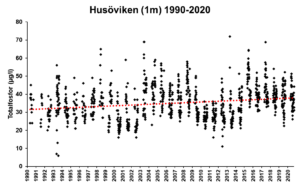
Total phosphorus content in Husöviken’s surface water 1990-2020 during the summer (May-September), the red line = linear trend line
Scientific publications
Under construction.

Environmental and Marine Biology
We are living in a continually changing environment, with the changes largely caused by human activity and lifestyles.

Environmental and Marine Biology – research and personnel
Forskningen inom miljö- och marinbiologin är inriktad på marinbiologi, ekologi och miljöforskning, samt beteende- och evolutionsekologiska frågeställningar. Vår marina miljöforskning är primärt fokuserad på kustbygdernas
The Sea
Marine biology is a research-intensive subject with a strong international orientation. Since June 2017, The Sea has been one of our four focal areas in
Master’s Programme in Biosciences
Through research and practical application, a bioscientist can save human and animal lives, develop new cures for diseases or come up with methods and products