



About the ceremony
Åbo Akademi University’s Conferral Tradition, History and Conferral Glossary
Here you will find information about Åbo Akademi University’s long-standing conferral tradition. Explore the history and significance of the ceremony, as well as key concepts explained in the conferral glossary. Learn what it means to be conferred and become acquainted with the various roles and ceremonial elements associated with the conferral ceremony.
Information about past conferral ceremonies of 2018, 2022 and 2025 can be found on separate pages.
Cenferral Ceremony as a tradition
Conferral Ceremony at Åbo Akademi Univeristy
The conferral ceremony is one of the most tradition-rich academic ceremonies. It is a formal occasion at which a university officially confers its newly graduated doctors. During the ceremony, those being conferred (promovendi) receive the insignia of their new academic dignity, typically including the doctoral hat, sword, and diploma.
The most solemn academic event is undoubtedly the conferral ceremony. It is at this ceremony that those who have completed their degrees are formally conferred the dignity of doctor or master. Unlike several other universities in Finland, Åbo Akademi University does not organise master’s conferral ceremonies. Historically, the conferral ceremony also had a legal significance. Today, its significance is primarily symbolic, and participation is entirely voluntary.
For many graduates, the doctoral conferral ceremony represents the culmination of their academic career. For those who continue in research, it serves as a gateway into the academic community, where the conferral ceremony remains one of many cherished academic traditions. Promovendi often look forward to the conferral ceremony as a unique and memorable experience that stands apart from ordinary academic events.
Tradition
Bologna and Paris are generally regarded as the earliest university cities. Conferral ceremonies were already being held there during the thirteenth century. Many of the traditions, customs and symbols adopted by modern universities originate from these medieval institutions. At Uppsala University, founded in 1477, a solemn university celebration known as a conferral ceremony is believed to have been held as early as the late 1480s. Åbo Akademi University has, in turn, preserved several conferral traditions inherited from the Royal Academy of Turku (1640), which itself drew inspiration from Uppsala. These include the traditional conferral terminology, the use of Latin, the ceremonial sceptres, and the appointment of honorary doctors.
At the Royal Academy of Turku (1640–1827), the conferral tradition was established at an early stage. The first conferral ceremony of the Faculty of Philosophy was held in 1643, only three years after the Academy was founded. The tradition has continued almost uninterrupted ever since. Åbo Akademi University has retained many of the conferral customs of the Royal Academy. The first conferral ceremony at Åbo Akademi University was organised in 1927. During the twentieth century, both master’s and doctoral conferral ceremonies were held, either by individual faculties or jointly by the entire University. During the twenty-first century, the University has organised joint doctoral conferral ceremonies every second or third year.
The conferral festivities at Åbo Akademi University traditionally include a procession, the conferral act, a conferral service, and a banquet. The promoters address the promovendi in Latin while conferring the insignia. The ceremonial sceptres, symbolising the legal autonomy of the University, are carried at the head of the procession. Latin, inherited from the traditions of Uppsala and the Royal Academy of Turku, also plays a central role in the ceremony. The conferral act itself is conducted in Latin for all disciplines, although promotions in Information Technology and Chemical Engineering may exceptionally be conducted in Swedish. The diploma, too, is written in Latin.
Conferral Ceremonies at Åbo Akademi University
The first conferral ceremony at Åbo Akademi University was held in 1927. On that occasion, both master’s and doctoral degrees were conferred. The same applied to the next university-wide conferral ceremony in 1948. In 1934, the Faculty of Theology celebrated its tenth anniversary by organising its own conferral ceremony.
The conferral ceremony of 2027 therefore marks 100 years since the first conferral ceremony at Åbo Akademi University and will be the thirtieth conferral ceremony in the University’s history.
Jubilee doctors were conferred in 1978, 1998, 2005, 2008, 2011, 2014, 2016, 2018, 2022, and 2025. Once fifty years have passed since an individual was conferred as a doctor, he or she may be conferred as a Jubilee Doctor.
Previous Conferral Ceremonies
Please note that the pages are primarily in Swedish.
2025 Doktorspromotion
2022 Doktorspromotion
2018 Doktorspromotion
2016 Doktorspromotion (webbsida saknas)
2014 Doktorspromotion
2011 Doktorspromotion
2008 Doktorspromotion
2005 Doktorspromotion
2002 Doktorspromotion
1999 Doktorspromotion vid Österbottens högskola för två fakulteter ( 25-årsjubileum)
1999 Doktorspromotion vid Teologiska fakulteten (75-årsjubileum)
1998 Gemensam doktorspromotion
1993 Gemensam doktorspromotion
1990 Högskoleväsendets 350-årsjubileum; promotion av hedersdoktorer
1988 Gemensam doktorspromotion
1984 Doktorspromotion vid Teologiska fakulteten (60-årsjubileum)
1981 Lars Erik Taxell promoverades till hedersdoktor
1978 Doktorspromotion vid Handelshögskolan, gemensam med Åbo Akademi
1977 Promotion av hedersdoktorer vid Handelshögskolan vid Åbo Akademis 50-årsjubileum
1974 Doktorspromotionen vid Teologiska fakulteten (50-årsjubileum)
1968 Gemensam doktorspromotion
1964 Doktorspromotion vid Teologiska fakulteten (40-årsjubileum)
1963 Förlänande av hedersdoktorsgrad och doktorspromotion vid KTF
1958 Promotion av hedersdoktorer vid Handelshögskolan vid Åbo Akademi
1955 Doktorspromotion vid Teologiska fakulteten
1948 Gemensam magisters- och doktorspromotion
1947 Doktorspromotion
1934 Doktorspromotion vid Teologiska fakulteten (10-årsjubileum)
1927 Gemensam magisters- och doktorspromotion
Conferral Ceremony Glossary
Conferment or Promovere
The Latin verb promovere means “to move forward” or “to promote.” The person being conferred, the promovendus, is promoted to their new dignity by the conferrer (or promotor), who also presents the insignia to the newly conferred doctor.
Conferrer
A promotor or conferrer is a person who holds both the title of Professor and Doctor, and who is appointed by the respective faculty to perform the act of conferment for new Doctors as well as Honorary and Jubilee Doctors during the conferral ceremony.
Promovendi
Promovendi is Latin for “those who are to be conferred.” The term refers to those who are ceremonially promoted to the degree of Doctor at an academic conferral ceremony. The word derives from the Latin verb promovere, meaning “to promote” or “to move forward.”
Jubilee Doctor
Doctor semisaecularis. The title of Jubilee Doctor is conferred upon persons who earned their doctoral degrees 50 years ago. The title recognises fifty years of academic achievement and is conferred with honour during the conferral ceremony. For more information see page Honorary and Jubilee Doctor at Åbo Akademi University
Honorary Doctor
Doctor honoris causa is the title conferred upon a person who, regardless of whether they hold a doctoral degree, is awarded a doctorate in recognition of outstanding contributions to science, culture, academia, or society. The title is an honorary distinction and is conferred during the doctoral conferral ceremony.
At Åbo Akademi University, honorary doctors are appointed by the faculties. In addition, the Rector may appoint two honorary doctors. For further information, please see the page Honorary and Jubilee Doctor at Åbo Akademi University
Procession
An academic procession is a solemn ceremonial parade that forms part of an academic ceremony, such as a doctoral conferral ceremony or the installation of professors. Following traditions that date back to the Middle Ages, the procession serves to honour academic achievement and includes newly conferred doctors or professors, the Chancellor, the Rector, professors, and members of the academic staff dressed in formal academic attire.
At Åbo Akademi University, all promovendi — newly graduated doctors, jubilee doctors, and honorary doctors — take part in the conferral procession. The procession also includes marshals, flag bearers, the Chancellor, the Rector, professors, members of the academic staff, and rectors from other universities. The University’s regalia, including the ceremonial sceptres that symbolise the University’s legal autonomy, are carried in the procession.
The conferral ceremony begins with the procession entering the ceremonial hall and concludes with the procession leaving the hall.
The procession is one of Åbo Akademi University’s oldest and most distinguished traditions, with roots reaching back to the seventeenth century. Following the conferral act, the newly conferred doctors, the University leadership, and honorary guests traditionally proceed in a solemn procession, walking in pairs to Turku Cathedral for an ecumenical conferral service.
Head Marshal
Together with the Master of Ceremonies, the Head Marshal ensures that the conferment festivities proceed smoothly. At Åbo Akademi University, the Head Marshal wears a blue marshal’s sash. The Head Marshal is usually a professor from the faculty who is in the middle or later stages of their academic career.
The Master of Ceremonies and the Head Marshal lead the procession and guide the graduands to their seats during the conferment ceremony. At the banquet, the Master of Ceremonies and the Head Marshal jointly oversee and lead the ceremonial programme.
Master of Ceremonies
The Master of Ceremonies leads the festivities and ensures that the ceremonies during the Conferment Ceremony and other conferment events proceed smoothly. At Åbo Akademi University, the Master of Ceremonies wears a red marshal’s sash. The role is usually assigned to a professor from the faculty who is in the middle or later stages of their academic career.
The Master of Ceremonies and the Head Marshal lead the procession and guide the graduands to their seats during the conferment ceremony. At the banquet, the ceremonial programme is led by the Master of Ceremonies and the Head Marshal.
University Sceptres
The university sceptres form part of the University’s ceremonial regalia. In an academic context, the sceptres symbolize the institution’s legal autonomy and special status. At Åbo Akademi University, they are nowadays used only at conferment ceremonies and rectorial inaugurations. They are carried into the ceremonial hall at the head of the procession, that is, the academic procession comprising all promovendi, visiting chancellors and rectors, and representatives of the University.
The sceptres are carried by two officials known as bedels.
Bedels
The university sceptres are carried in by two individuals known as bedels. The title originates from Uppsala, where these individuals originally served as royal attendants. At Åbo Akademi University, the role of bedel is performed by two students.
The term derives from the Latin pedellus and dates back to the Middle Ages, when bedels also held policing and disciplinary authority within the university community. Today, the role is primarily ceremonial, and the bedels carry the university sceptres at the head of the academic procession.
Marshals, Flag Bearers and Standard
During the conferment ceremonies, marshals welcome participants and provide information at the various festivities. The marshals wear blue-and-white sashes and student caps. Their duties during, for example, a doctoral conferment ceremony include serving as hosts, guiding guests, distributing programmes, and participating in the academic procession carrying flags and standards. The marshals also play a vital role in creating and maintaining the academic atmosphere throughout the celebrations.
In Turku, academic processions and the traditions associated with flag and standard bearers are deeply rooted and form an important part of academic ceremonial culture, particularly in connection with Åbo Akademi University, the Student Union of Åbo Akademi University, and the city’s student community.
During the Conferral Ceremony, flag bearers lead the procession from the ceremony venue to Turku Cathedral for the conferral service that traditionally concludes the ceremony.
The roles of flag bearers and marshals are most often performed by students. The positions of Head Marshal and Master of Ceremonies, however, are reserved exclusively for professors of the University.
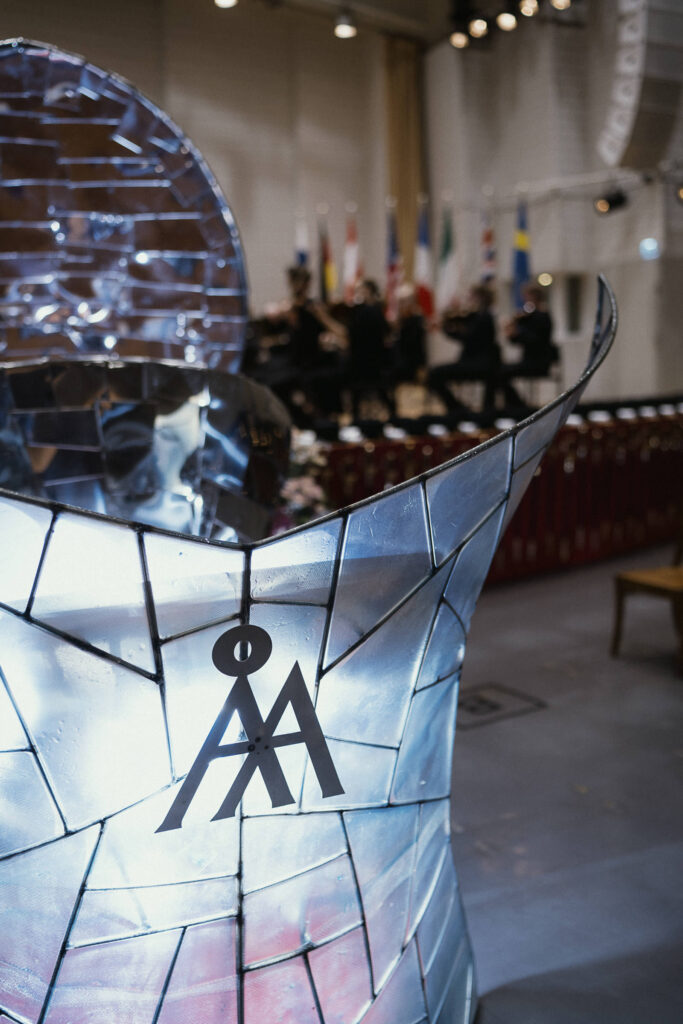
Åbo Akademi University’s ceremonial standard was presented to the University on 11 October 1919 during its inaugural celebrations. The standard is displayed on stage during the Conferral Ceremony.
Insignia – Hatt, Lyre, Sword and Diploma
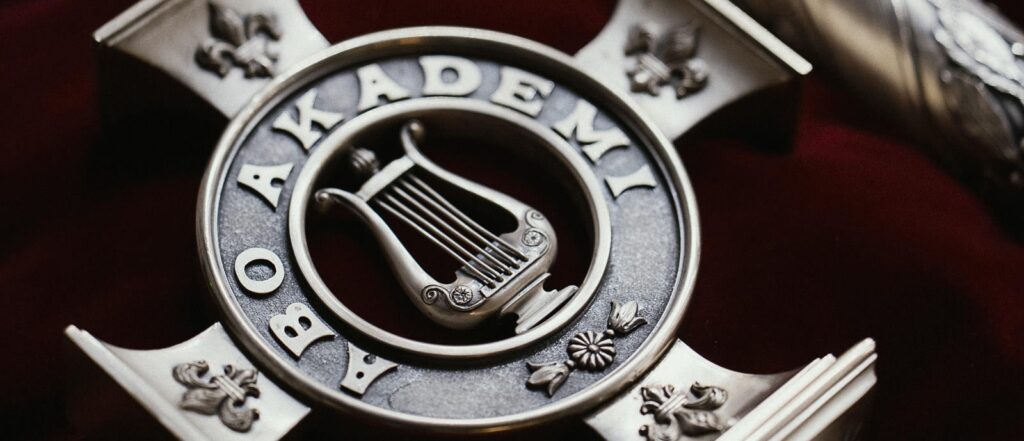
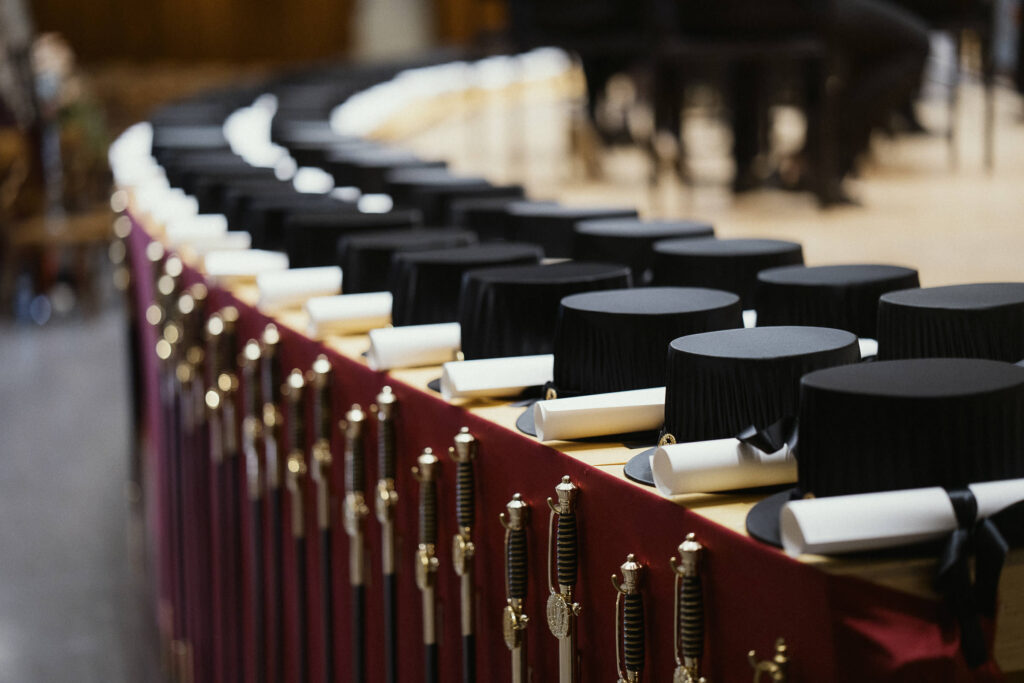
The insignia are the outward symbols of the doctoral degree. Everyone conferred a doctoral degree at Åbo Akademi University receives a doctoral hat and a diploma. The design of the hat and its lyre (or, in some cases, the absence of a lyre) varies according to the degree. Certain degrees are also associated with additional insignia, such as a doctoral sword, an embroidered collar, or a brooch.
Doctoral Hat
At Åbo Akademi University, all doctors wear a doctoral hat as part of their insignia. The doctoral hat symbolizes academic freedom.
The colour of the hat may vary depending on the degree, but at Åbo Akademi University all doctoral hats are black, with the exception of the Doctor of Laws hat, which is dark red. The brims are straight on all hats except those of Doctors of Technology, whose hats feature upturned brims.
All doctoral hats are adorned with a lyre, except for the hat worn by Doctors of Theology, which instead features a band symbolizing the clerical collar.
Lyre
All doctoral hats at Åbo Akademi University bear a lyre, with the exception of the theological doctoral hat, which carries only the symbolic band.
Most faculties and disciplines at the University use the philosophical lyre of the University of Helsinki, featuring the academic lyre surrounded by a laurel wreath. Doctors of Technology use a distinctive lyre in which a benzene ring is encircled by a laurel wreath. The lyre of Doctors of Economics incorporates the caduceus entwined by two serpents and framed by laurel leaves and lilies. Doctors of Laws wear the legal lyre of the University of Helsinki. Since 2025, Doctors of Pharmacy have also used a lyre developed specifically for Åbo Akademi University.
Diploma
The Conferral Diploma is the formal certificate of the doctoral dignity. It is presented during the Conferral Ceremony, together with any accompanying insignia. Written in Latin, the diploma is rolled and sealed with the University’s official seal.
Conferral procedure
The conferral procedure—the part of the Conferral Ceremony during which the conferrers formally confer the doctoral dignity upon the graduands—is conducted in Latin. The conferral follows a traditional structure and order.
At Åbo Akademi University, conferrers are appointed for the following academic fields:
- Humanities, Psychology and Logopedics
- Theology
- Education
- Social Sciences
- Economics and Law
- Natural Sciences and Health Sciences
- Technology
Each conferrer begins with a greeting, after which they don their doctoral hat and commence the conferral of degrees within their field.
Within each field, the conferral always proceeds in the following order:
- Jubilee Doctors
- Honorary Doctors
- New Doctors
After completing the conferral for their field, the conferrer concludes with a greeting, whereupon the next conferrer takes over and continues the ceremony.
Harangue – conferrer speaks Latin
The harangue is the part of the Conferral Ceremony during which the conferrer formally confers the doctoral degree upon the graduands. The entire conferral procedure is conducted in Latin, following centuries-old academic tradition.
Some commonly heard Latin expressions include:
- Academia Aboensis – Åbo Akademi University
- Huc igitur procedite, ut insignia dignitatis a me accipiatis.
Come forward, therefore, that you may receive the insignia of your dignity from me.
(Spoken when the conferrer invites a new group of graduands to step forward for conferral.) - Accipe pileum, accipe gladium, accipe diploma.
Receive the hat, receive the sword, receive the diploma.
(Spoken when the conferrer presents the insignia to the promovendi.) - Valete, praeclarissimi doctores.
Farewell, most distinguished doctors.
(The conferrer’s closing greeting after all new doctors within the field have been conferred.) - Dixi.
I have spoken.
(The traditional conclusion of the conferrer’s address.)
The harangue is one of the most solemn and distinctive elements of the Conferral Ceremony, preserving the role of Latin as the historic language of scholarship and the Nordic university tradition.
Absens
Absens is a Latin term meaning absent, missing, or away. An absent graduand is a person who participates in the Conferral Ceremony in absentia rather than being present at the ceremony itself.
The absent graduand’s name is included in the official conferral publication, and they are granted the right to use the academic insignia conferred during the ceremony. However, since the doctoral dignity has already been conferred, the graduand cannot be formally conferred again at a later conferral ceremony.
Promotionsskrift
The Conferral Publication is the official commemorative publication of the Conferral Ceremony.
It contains a list of all those conferred, including their names, doctoral degrees, year of graduation, and the titles of their doctoral theses. The publication also includes more extensive presentations of the Honorary Doctors and presentations of the Jubilee Doctors.
In addition, the Conferral Publication features the programme of the festivities, speeches delivered during the celebrations, and, where applicable, historical essays and descriptive texts related to the conferral tradition and the ceremony itself.
As both a ceremonial document and a historical record, the Conferral Publication preserves the memory of each Conferral Ceremony and those who take part in it.
Solemn act
A Solemn Act is the most formal and ceremonial part of an academic celebration, such as a Conferral Ceremony or the anniversary festivities of a student organisation. During this ceremony, the programme typically includes an academic procession with flags and standards, speeches, musical performances, and the conferral of academic honours and distinctions. At some academic celebrations, official greetings and gifts are also presented by participating organisations, although this does not form part of the Conferral Ceremony at Åbo Akademi University.
When attending a Solemn Act, such as a Conferral Ceremony at Åbo Akademi University, it is important to observe academic customs and etiquette.
Dress Code
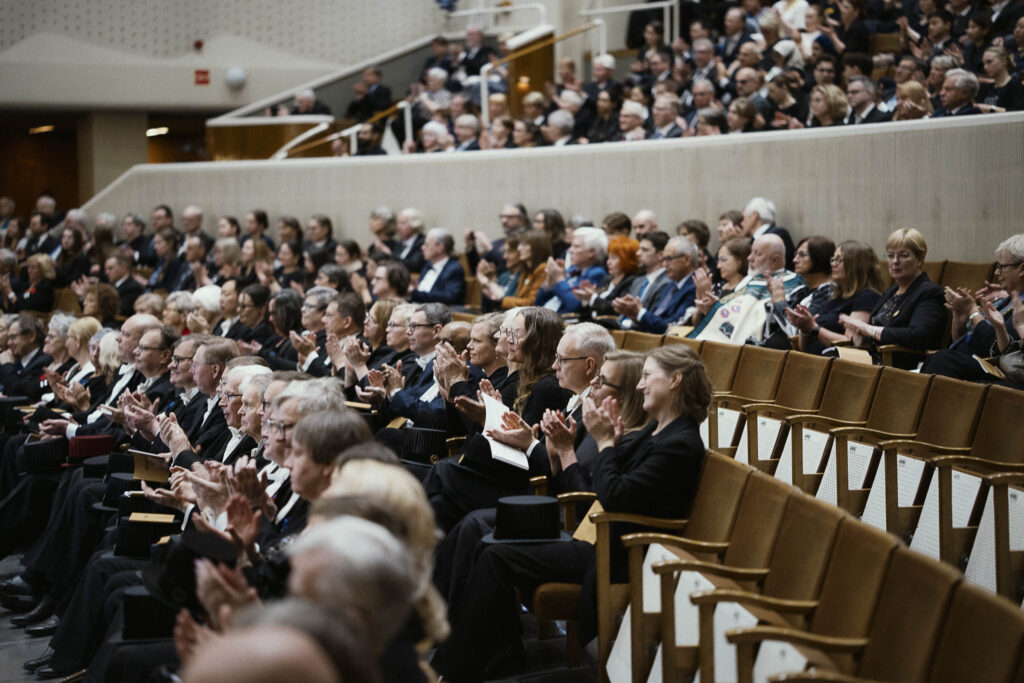
The dress code is generally strict, especially for graduands, while guests may have greater flexibility depending on the event instructions. Academic decorations and orders are worn according to established conventions. Members of the audience who have previously earned and been conferred a doctoral degree may wear their doctoral hats in accordance with the guidelines outlined below.
Punctuality
The ceremony is highly formal, and late arrival is considered inappropriate. Doors are often closed once the ceremony has begun, and late entry may not be permitted.
Silence and Respect
All participants rise when the academic procession, flags, standards, and University leadership enter and leave the hall. When Jubilee Doctors are conferred, all participants also rise, usually following a signal from the conferrer.
Absolute silence is observed during speeches and formal addresses. Mobile phones must be switched off completely throughout the ceremony.
Following the Solemn Act, the celebrations typically continue in a more festive setting. In the case of the Conferral Ceremony, the festivities culminate in the Conferral Banquet held later in the evening.
Doctoral Hats Among Guests and Members of the Audience
According to academic tradition, guests who already possess a doctoral hat carry it on their left arm during the opening part of the ceremony.
When the conferrer for their own faculty or discipline puts on their doctoral hat to begin the conferral, previously conferred doctors in the audience also put on their hats.
Quick Guide to Wearing the Doctoral Hat
Entering the venue
The doctoral hat is carried on the left arm and not worn on the head.
Putting on the hat
The hat is put on at the same moment that the conferrer of your own faculty or discipline puts on their hat.
During the ceremony
The hat is worn for the remainder of the ceremony.
Exception
During the singing of the Finnish national anthem, Maamme Laulu (Vårt land), men remove their hats while standing.
At the Conferral Banquet
The doctoral hat is not worn during the banquet. It is brought to the venue and left outside the dining hall in accordance with established tradition.
Conferral Cantata
A Conferral Cantata is a ceremonial musical work performed in connection with a Conferral Ceremony and forms an important artistic element of the festivities. Typically written for choir, soloists, and orchestra, a conferral cantata is often specially composed for the occasion.
Through its music and text, the cantata enhances the solemn atmosphere of the ceremony and underscores its symbolic significance. The texts frequently explore themes such as scholarship, learning, truth, and enlightenment, and may include tributes to both the newly conferred doctors and the traditions of the University.
In the Nordic academic tradition, including at Åbo Akademi University, conferral cantatas have long played an important role as an expression of the close relationship between science, scholarship, and the arts.
At Åbo Akademi University, the Conferral Cantata is performed by the Akademiska Orkestern (Academic Orchestra), together with singers from the choirs Brahe Djäknar, Florakören and Pedavoces, under the direction of their conductors.
Procession to Turku Cathedral
A ceremonial procession to Turku Cathedral has traditionally formed an important part of Åbo Akademi University’s Conferral Ceremony festivities. The procession usually departs from the venue of the Conferral Ceremony and proceeds through the city to the Cathedral in a predetermined order, with conferrers, Jubilee Doctors, Honorary Doctors, and graduands taking part in full academic dress.
For many years, the procession has marched from the Turku Concert Hall down Aninkaistenmäki towards Turku Cathedral. As the procession proceeds along the roadway, traffic is temporarily halted to allow the participants to pass safely and undisturbed.
The procession is a visible and ceremonial expression of the academic tradition. It connects the University with the city’s historical and cultural landscape, reinforces the solemn character of the Conferral Ceremony, and traditionally marks the transition to the conferral service held in the Cathedral.
Please note: No conferral service and no procession to Turku Cathedral will be organised in connection with the 2027 Conferral Ceremony, as the Cathedral will be closed for restoration works. The next conferral service will take place in conjunction with the 2029 Conferral Ceremony.
Conferral Ceremony Service
In keeping with a tradition dating back to the era of the Royal Academy of Turku, the Conferral Ceremony traditionally continues with an ecumenical service in Turku Cathedral.
The Conferral Service at Åbo Akademi University is a solemn ecclesiastical ceremony that forms part of the conferral festivities and highlights the spiritual dimension of the academic celebration. Held in Turku Cathedral, the service brings together graduands, conferrers, and other guests and participants for a moment of reflection, gratitude, and ceremonial fellowship.
The service combines academic tradition with Christian liturgy through prayers, hymns, music, and a sermon. Its themes often revolve around knowledge, responsibility, and humanity’s search for truth, providing an opportunity to reflect on the role of scholarship and science within a broader existential context. For many participants, the Conferral Service constitutes a meaningful and atmospheric part of the conferral celebrations and an important element of their traditional framework.
Academic Etiquette in the Cathedral
Upon entering Turku Cathedral, all participants remove their doctoral hats. Those carrying a doctoral sword leave it in the cathedral vestibule before entering the church.
Please note: No conferral service and no procession to Turku Cathedral will be organised in connection with the 2027 Conferral Ceremony, as the Cathedral will be closed for restoration works. The next conferral service will take place in conjunction with the 2029 Conferral Ceremony.
Conferral Banquet
The Conferral Banquet marks the culmination of the Conferral Ceremony festivities. This formal celebratory dinner brings together newly conferred doctors, guests, and members of the academic community for an evening of speeches, music, entertainment, and dancing.
All newly conferred doctors are invited to attend the banquet together with an accompanying guest. Professors, University staff, and other invited guests also participate in the celebration.
The banquet is one of the highlights of the conferral festivities, combining academic tradition with social celebration. Formal speeches, artistic performances, and ceremonial toasts are interspersed with dining, creating an atmosphere of festivity and fellowship. The evening traditionally concludes with dancing and continued celebrations.
Conferral Ceremony
Start


Promovendi
Info
FAQ
Insignia
Honorary Doctors
Honorary and Jubilee Doctor at Åbo Akademis University
Family members and Guests
Info and programme
Attire