


HR Excellence in Research


The HR Excellence in Research process is a tool of the European Commission to help institutions of higher education and research develop their activities in line with the principles in the European Charter for Researchers and the Code of Conduct for the Recruitment of Researchers (Charter & Code).
The Charter & Code consist of 40 fundamental principles supporting the creation of attractive research careers and favourable working conditions for researchers throughout Europe. The principles are organized under four thematic headings:
- Ethical and Professional Aspects
- Recruitment and Selection
- Working Conditions and Social Security
- Training and Development
Together, the European Charter for Researchers and the Code of Conduct for the Recruitment of Researchers form the foundation of the HR Excellence in Research Award.


HR Excellence in Research at Åbo Akademi University
Åbo Akademi University is committed to improving working conditions and recruitment processes for researchers. This commitment has been recognized through the HR Excellence in Research Award, which ÅAU received in December 2020.
The HR Excellence in Research work at Åbo Akademi University is overseen by a steering group and a project group and is carried out consistently with related activities and development projects at the University (e.g. the continuous strategy work, the work on gender equality and non-discrimination, and work on open science).
During the initial phase of the HR Excellence in Research process, researchers and administrators collaborated to analyse how the principles of the Charter & Code were being implemented at Åbo Akademi University. This analysis covered regulations, steering documents, and current practices. Based on the findings, an Action Plan 2020-2022 following the HR Excellence in Research template was designed to address identified shortcomings and further develop activities related to researchers’ working conditions and recruitment.
Action Plan 2020-2022
As part of the Action Plan 2020–2022, Åbo Akademi University carried out several key activities to strengthen research practices and working conditions. These included:
- Implementing annual and systematic open calls for ÅAU-funded doctoral researcher positions, as part of the strategic work, and introducing a shared onbording programme for new and existing doctoral researchers.
- Arranging topical researcher training, in for instance GDPR-related training and safety protocols.
- Improving accessibility to information by systematically providing all relevant information in both Swedish and English in internal communication.
- Raising awareness and educating in the process of addressing issues in the workplace and study environment, including the process of complaints.
- Reviewing the internal recruitment guide, and providing clear instructions for each stage of the recruitment process following the principles of Open, Transparent, and Merit-Based Recruitment (OTM-R)
Implementation and Strategic Development 2023-2025
Although no separate action plan was formally adopted for 2023-2025, the implementation of measures from the 2020-2022 action plan continued throughout the period. In parallel, several strategic initiatives and development activities were undertaken to strengthen leadership, research, internationalization, equality, and staff support. Together, these activities contributed to the achievement of Åbo Akademi University’s long-term strategic objectives.
Strategy and organisational development
- Preparation and implementation of the Åbo Akademi University Strategy 2025-2030, ensuring that equality, inclusion, and sustainable personnel practices were reflected in the university’s future direction.
- Reform of the Åbo Akademi University Graduate School, implemented on 1 January 2025, with the aim of strengthening doctoral education and research support structures.
Leadership and managerial support
- Manager Support support materials were developed on the intranet in autumn 2023, providing managers with clear guidance and support material related to their responsibilities.
Internationalization and support for international staff
- Updated information resources for international staff and researchers, including a dedicated external webpage and information package.
- Support materials for managers and recruiting supervisors involved in international recruitment and onboarding processes.
Equality, inclusion, and a respectful workplace
- Introduced recommendations on gender-neutral language in communications to promote inclusive and respectful communication.
- Implemented the training programme “A Safe Workplace” for managers and employees, addressing workplace bullying, responsible workplace behaviour, and sexual harassment.
- Continued to strengthen awareness of equality, diversity, and inclusion through training and communication activities.
Researcher development and competence building
- Expansion of the range of staff development opportunities available to researchers, offering approximately twenty training courses annually for researchers at different career stages.
- Continued support for competence development and career progression through a structured staff training curriculum.
Interim Assessment and Action Plan 2026-2029
In 2023, Åbo Akademi University conducted an interim assessment as part of the HRS4R implementation phase. This evaluation provided valuable insights into the progress made since the initial Action Plan and highlighted areas where further development was needed. Based on the results, Åbo Akademi University has continued to strengthen its practices by engaging in discussion sessions with different researcher groups and involving stakeholders in shaping the next steps.
The outcomes of the 2023 interim assessment, together with input from these stakeholder discussions, form the foundation for a new Action Plan that will be implemented during the years 2026–2029:
Action Plan 2026-2029
Action 1: Review funding models for doctoral researchers
Conduct a mapping and analysis of existing funding models for doctoral researchers to identify potential needs for updating or supplementing the university’s funding structures, including recommendations on funding requirements at admission and follow-up processes.
Planned completion: Q2 2027
Action 2: Clarify support and rights for grant-funded
researchers
Create a single intranet entry point clarifying support structures and rights for researchers on scholarships, including access to facilities and services. Key information may also be made available on external webpages.
Planned completion: Q2 2027
Action 3: Improve access to and visibility of staff development opportunities
Make staff training programmes more visible and clarify access for grant-funded researchers, including pedagogical training, leadership training, and career development. Clearly communicate target groups for each opportunity and note any participation restrictions.
Planned completion: Q4 2026
Action 4: Pilot mentoring support for principal investigators
Piloting a mentoring programme for professors and senior researchers with PI responsibilities, combining internal mentoring with existing managerial support structures.
Planned completion: Q3 2027
Action 5: Strengthen mentoring opportunities for doctoral and postdoctoral researchers
Promoting and further developing the joint ÅAU–UTU mentoring programme for postdoctoral and doctoral researchers.
Planned completion: Q3 2026
Action 6: Recognise mentoring contributions
Ensuring formal recognition of mentoring within the organization.
Planned completion: Q2 2027
Action 7: Strengthen post-award project support
Strengthen Post award support for PI:s and project coordinators, including maintaining an overview of coordinators for major projects and clear links to the Post award team.
Planned completion: Q4 2027
Action 8: Promote peer support within research groups
Encourage mentoring and collaboration within research groups, particularly among senior researchers and professors.
Planned completion: Q4 2027
Action 9: Expand project management guidance
Expand and update intranet-based guides and support materials.
Planned completion: Q4 2026
Action 10: Establish guidelines for parallel language use
Clarify principles for parallel language use by developing unit-level guidelines specifying which information must be available in both Swedish and English, and how language considerations should be integrated into everyday practices, including in smaller workplaces.
Planned completion: Q4 2027
Action 11: Strengthen Swedish language inclusion
Develop and implement a structured model for integration in Swedish for staff whose first language is not Swedish, including allocated working time for language learning, workplace-based language support, and flexible, needs-based learning formats.
Planned completion: Q3 2027
Action 12: Clarify career expectations and progression
Describe academic personnel groups on the website and intranet, including position-specific guidance on required qualifications and experience in research (e.g. publications), teaching, supervision, and societal interaction. Define minimum outcome targets and ensure they are set at an appropriate level.
Planned completion: Q4 2027
Action 13: Strengthen development discussions
Update and clarify the model for development discussions to strengthen the alignment between agreed goals, expectations, follow-up including the relation of goals set to the assessment of personal performance according to the Collective Agreement for Universities.
Planned completion: Q1 2026
Action 14: Expand supervisor training
Provide more supervision training for all supervisors, structured around key thematic areas.
Planned completion: Q4 2026
Action 15: Develop advanced research ethics training
Develop a course in research ethics and responsible research practices, building on and further developing the existing Responsible Research Practices course (2 ECTS), with both mandatory and optional components.
Planned completion: Q2 2027
Action 16: Create a pedagogical training pathway
Establish a pedagogical training pathway for doctoral and postdoctoral researchers involved in teaching, including opportunities for teaching practice and recognition of supervision activities through credits in the doctoral degree.
Planned completion: Q2 2027
Action 17: Pilot narrative CVs in recruitment
Pilot the use of narrative CVs in recruitment and research evaluation by providing standardised templates (e.g. TENK‑compliant and shorter narrative CVs) for different purposes. Ensure that job advertisements and research application guidelines clearly state which CV template should be used.
Planned completion: Q4 2026
Action 18: Improve recruitment feedback mechanisms
Develop integrated feedback mechanisms in the recruitment tool to support transparent and systematic evaluation processes.
Planned completion: Q3 2026
Action 19: Strengthen data protection guidance for researchers
Update the mandatory information security test with researcher-relevant data protection content.
Planned completion: Q3 2026
Action 20: Build competence in data anonymisation
Offer training in anonymization to strengthen responsible research data management and data protection.
Planned completion: Q2 2026
Action 21: Supporting an inclusive community
Offer a self-study course on respect and inclusion to all staff, with targeted training components adapted to different staff groups and roles. The compulsory self-study course on respect and inclusion is launched, with targeted training.
Planned completion: Q3 2026
Action 22: Strengthen visibility of non-discrimination principles
Ensure that the ÅAU statement on non-discrimination is clearly and visibly communicated on the webpages.
Planned completion: Q4 2026
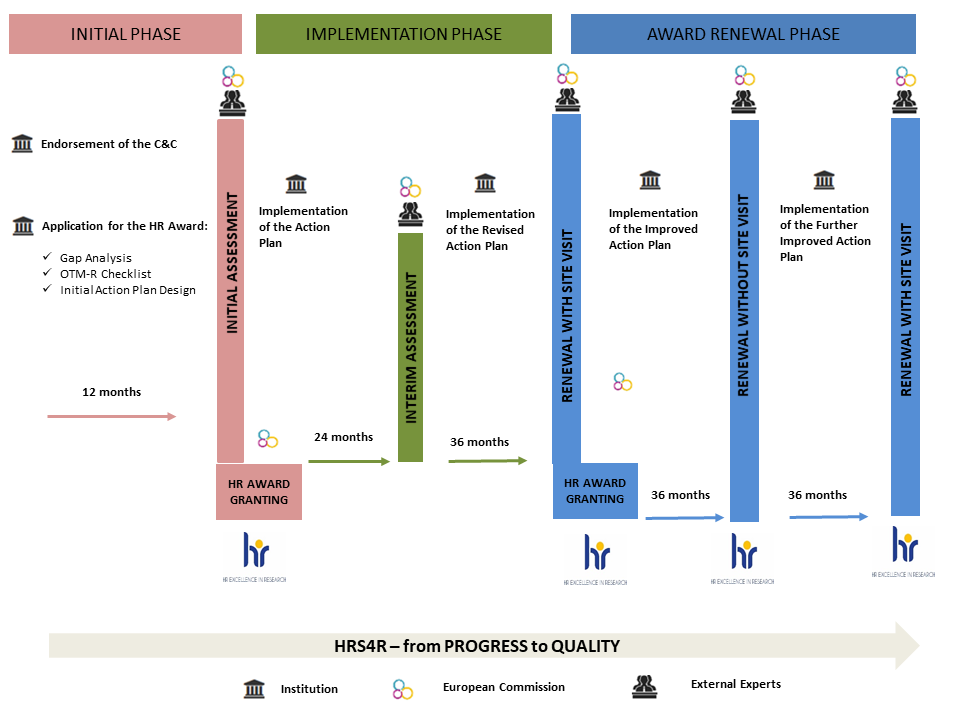
Looking ahead, Åbo Akademi University will carry out a self‑evaluation in November 2026, followed by a site visit from HR Excellence in Research evaluators. These steps are part of the continuous monitoring and improvement process, ensuring that the principles of the Charter & Code remain firmly embedded in the university’s operations.
The following illustration provides an overview of the HRS4R process:
Openness, Transparency, and Merit‑Based Recruitment
Åbo Akademi University is also committed to openness, transparency, and merit‑based recruitment processes. We foster an inclusive, dynamic environment that values openness, sustainability, and professional growth. Through HR Excellence in Research and the OTM‑R principles, we ensure fair and transparent recruitment and support continuous development for all staff and researchers.
The assessment of researchers and research follows the guidelines of TENK: Good Practice in Researcher Evaluation, including the national recommendation on the responsible use of publication metrics. Since 2024, the university has also committed to the CoARA principles (The Coalition for Advancing Research Assessment), reforming the methods and processes by which research, researchers, and research organizations are evaluated.
CoARA Commitment at ÅAU
Since 2024, Åbo Akademi University has been a signatory to the CoARA Agreement (Coalition for Advancing Research Assessment), aimed at promoting diversity, fairness, transparency, and inclusion in research assessment. This commitment supports researchers and projects across career stages and disciplines and is a key part of ÅAU’s researcher’s strategy and the HRS4R.
The university participates and shares how it reviews and develops assessment criteria, tools, and processes in line with CoARA’s core commitments and following an action plan with defined milestones. The Research Strategy Council (FoR) oversees the development and implementation of this plan, involving stakeholders from all career stages.
The ÅAU CoARA Action Plan covers 2025–2029. In 2025, the focus has been on creating internal and external communication channels and planning feedback mechanisms in the recruitment system. This will continue in 2026. The action plan also emphasizes participation in networks, updating practices based on feedback, and expanding reforms across departments and different networks. By 2027–2029, efforts will concentrate on fully integrating CoARA principles into research assessment practices, strengthening ÅAU’s research culture.
The Åbo Akademi University Strategy
The Åbo Akademi University Strategy sets the directions for the activities carried out at Åbo Akademi University. The Strategy 2030 defines four core values:
1) Knowledge: we take responsibility for safeguarding critical academic thinking, open science and the processes of credible knowledge production.
2) Community: we take responsibility for creating a sense of community in our activities, where our relatively small size and concentrated campus environments allow flexible interaction between students and staff.
3) Enabling: we take responsibility for providing competence development for tomorrow’s needs in an innovative environment.
4) Sustainability: through our activities, we take responsibility for contributing to economic, social, ecological, technological and cultural sustainability and we apply the principles in our own activities.
The directions and values are well in line with the Charter & Code. Openness, transparency, sustainability and quality in all activities are highlighted throughout the Strategy. Through our dedication to education and research, we play a crucial role in shaping a progressive and inclusive society:
“By working for the Swedish-speaking population in Finland, we simultaneously contribute to an open, democratic society together with other Finnish universities. Academic activities that focus on freedom of thought, speech, teaching and research foster active citizenship, human rights, equality, diversity, openness, education and critical thinking.”
Gender Equality, Equal Treatment, Inclusion and Accessibility
Åbo Akademi is committed to creating an inclusive study and work environment where everyone is treated equally and with respect. Our plan on Gender Equality, Equal Treatment, Inclusion and Accessibility aims to promote equality, non-discrimination, and accessibility by identifying and removing barriers that create inequality.
The plan includes goals and actions to ensure a safe environment free from discrimination, racism, and sexism, where both staff and students have equal opportunities to participate in all activities. The work is regularly monitored by the Equality Committee and forms part of our commitment to the UN Sustainable Development Goals.