



News


Why do we care about cats so much?
A cute cat video online, a picture of a stray cat in a Facebook group. It often seems as if our opinions about cats are stronger than our opinions about dogs, for example. Why is that? Why do cats evoke such strong feelings? We asked Arwen Meerboer, a doctoral student in philosophy. Here is her answer:
A cat is not a dog. These are lines from the last song of the popular mega-musical Cats, the less critically acclaimed Cats the movie musical even ends the movie by having Dame Judy Dench break the fourth wall and address this line to the audience. Much cultural context is devoted to posing cats and dogs as opposites of each other; cats are mean, cunning, independent and often culturally gendered as feminine. Dogs are loyal, simple, dependant, and often culturally gendered as masculine.
Cats are often regarded as having domesticated themselves. Though this origin story is more complicated, cats did move to human settlements because of our propensity to gather vermin like mice and rats and then stuck around until we let them inside. Cats still have the reputation of being more like a roommate than a pet, especially an outdoor cat has their own life and affaires, and sometimes you meet in the kitchen and have dinner together. Even indoor cats can disappear for hours on their own errands. Dogs do not have a cat’s talent for disappearances, they are nearly always visible and often audible, they are socially engaged with people.
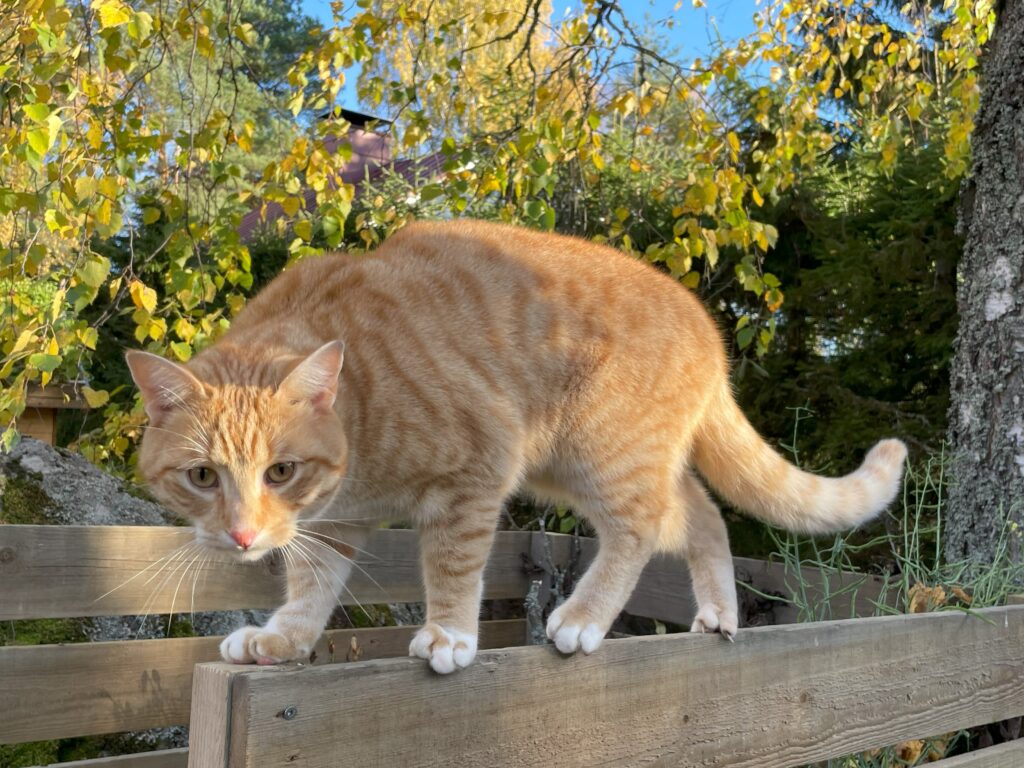
Photo: Catrin Sandvik
Dogs show their disapproval of unwanted guests by barking, or by a sulky kind of silence, if a cat doesn’t want to see guests the guests won’t see the cat. Dogs historically worked with humans, mostly men, to hunt or herd animals, while cats worked alone in the domestic sphere, keeping grains free from mice. This has resulted in our bond with cats and dogs being very different. Dogs are coworkers, we rely on them and communicate with them, cats are neighbours, we occupy the same spaces, but we do not get to know them unless we make an effort.
Cats have a notable social media presence; the internet is full of cat videos. Even though dogs and other pets get their fair share of attention, cat videos are a staple of the modern internet. Perhaps a part of the fascination with cat videos is that they give us a look at the world of the cat. We look at their difference, their activities that have nothing to do with us, and it fascinates us.

Photo: Private
The virtual and physical world is also full of concern over cats. Lost cat notices have largely moved online, and in localised groups on social media will often have posts about missing cats. What also happens is notices of found cats, these are cats seen around the neighbourhood that the poster doesn’t know. A found cat often has a home, but concerned locals want to know where it is. I have myself put found cat notices around my area when I lived in a flat where a cat would habitually use my open window to go into my flat. I worried that if this cat was a stray he would have nowhere to go if I started closing my window. I got an email almost immediately that he belonged to a flat two doors down from mine.
If cats are our neighbours, we have very few ways of checking in on them. We don’t instantly know if a cat alone is in danger or not, whereas in Finland, any other pet without a human nearby is cause for alarm. However, we also lack the ability to control cats, we cannot stop them from going into our houses or pooping in our yards or playgrounds, we cannot prevent them from eating small birds and rodents. And we worry about them joining the ever-growing population of wild cats that institutions like Dewi try to rehabilitate. We love that cats are strange and other to us, and we can look at them for hours, but their otherness also makes us feel both protective and a need to exercise control.
