



News


New Professor of Artificial Intelligence at Åbo Akademi University: “We must understand both opportunities and risks”
Artificial intelligence is reshaping both the workplace and everyday life at a pace few could have predicted. While the rapid development of AI is fuelling excitement, it is also raising concerns. According to Michael Cochez, it is essential to take the risks seriously while also recognising the possibilities technology offers. “The aim is to develop tools that augment human capability. That’s where I see the big opportunities.”
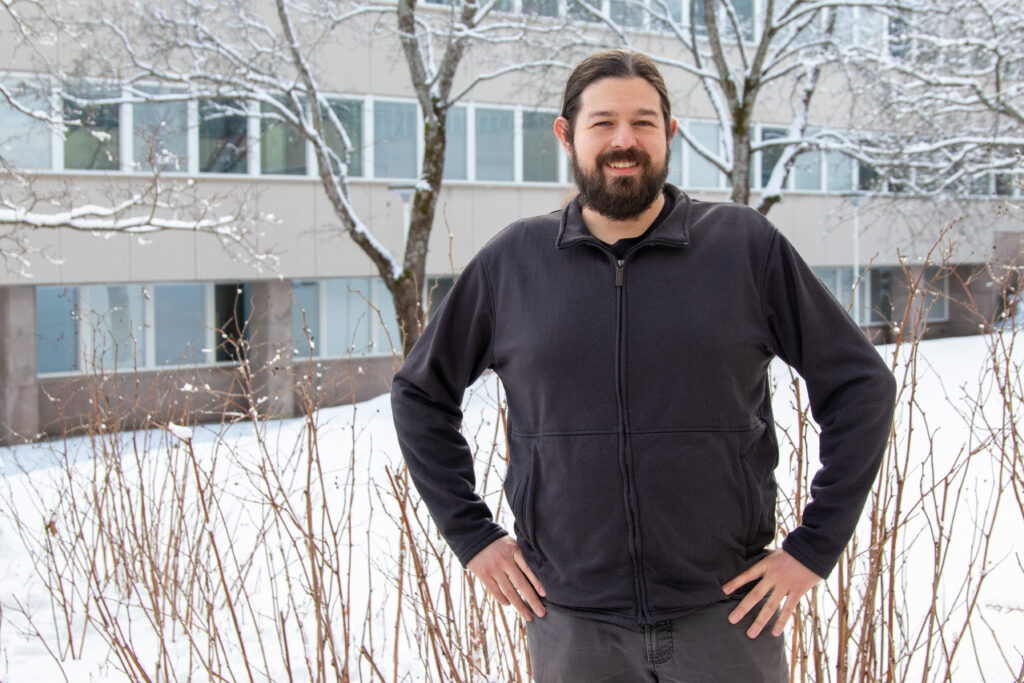
Michael Cochez has recently been appointed Professor and PS Fellow in Machine Learning and AI Engineering at Åbo Akademi University Cochez is one of several internationally recognised AI researchers recruited to the newly established ELLIS Institute Finland through a global selection process conducted in autumn 2025.
ELLIS Institute Finland is a new national research centre with an international profile, dedicated to research in artificial intelligence and machine learning. The institute forms part of а pan-European network that brings together leading researchers and promotes collaboration between academia, industry, and society.
Harnessing human understanding
Cochez’s research centres on machine learning and knowledge representation. While machine learning is a concept many people are familiar with, knowledge representation often sounds more abstract.
For Cochez, however, it is something very concrete: making AI systems able to work with structured information about the world.
Many AI systems today are trained by feeding them enormous volumes of data and allowing them to detect patterns independently. In his research, Cochez instead aims to provide systems with structure.
The idea is to give systems a description of how things work according to our understanding, rather than requiring them to learn everything from unstructured data.
“Imagine you want to teach someone multiplication. You could show them thousands upon thousands of calculations. That is essentially what we do with many AI systems today. What I try to do instead is teach the system how multiplication actually works.”
Providing AI systems with high‑level descriptions rather than vast collections of examples can make them faster, more efficient and less prone to error.
According to Cochez, this approach builds on humanity’s understanding of the world.
“The idea is to give systems a description of how things work according to our understanding, rather than requiring them to learn everything from unstructured data.”
Knowledge representation is already widely used in large-scale knowledge bases, from medicine and enterprise information systems to environmental data and research in the natural sciences.
The future of work may look different
Cochez frequently returns to the same central idea: AI should strengthen human capabilities rather than compete with them. Technological development is often portrayed as a race between humans and machines, he notes, but this narrative is misleading.
“We want systems that are better than humans at tasks we cannot do well ourselves. Not systems that take over activities we do for enjoyment,” Cochez explains.
“Take football as an example. If robots became better at playing football than humans, what would we actually gain from that? The point is not to replace the sport. Research in robotics focuses on systems capable of operating in hazardous environments, not on competing with athletes.”
The aim is to develop tools that augment human capability.
AI’s potential lies in complex and high-risk tasks. This might involve taking over hazardous work, supporting advanced medical diagnostics, or helping researchers interpret enormous datasets in environmental and climate science. In such contexts, the technology becomes a tool that can free up human time, improve safety and expand the boundaries of what we can achieve.
“The aim is to develop tools that augment human capability.”
At the same time, Cochez emphasises that the transition will not be without consequences. AI is likely to reshape the labour market in fundamental ways.
“We expect that many of today’s jobs will be taken over by AI systems. That fear is very realistic. I don’t know whether there will be enough work for everyone in the same way as today. As a society, we may need to decide to work less.”
The speed of technological progress has also exceeded what many experts previously expected.
“If you had asked me five or six years ago whether we would be where we are today, I would have said no.”
AI expertise strengthens Åbo Akademi University
Having a PS Fellow affiliated with Åbo Akademi University gives the university access to expertise that is often concentrated at larger institutions.
“A single researcher has too little context. You need a network and a research environment to work in,” says Cochez.
Through the ELLIS Institute, Åbo Akademi University becomes part of an international network of leading AI researchers across Europe. For students and researchers alike, this provides a direct gateway to a wider European research community.
We expect that many of today’s jobs will be taken over by AI systems. That fear is very realistic.
Cochez also highlights the strong research environment in Turku and the close collaboration with the University of Turku. He points to the partnership around Turku BioImaging, which is jointly run by Åbo Akademi University and the University of Turku. The centre offers advanced research infrastructure for bioimaging and hosts extensive collections of biological and biomedical imaging data for research purposes. He also highlights the TurkuNLP group at the University of Turku, which specializes in language technology.
“When you have both large amounts of data and strong expertise, there is great potential to do very interesting things together.”
Finland in a wider AI landscape
Finland and Europe currently face intense global competition. Much of the progress in the field of artificial intelligence is driven by the United States and China, where investment levels and available resources significantly exceed those in Europe.
“We are in a different weight class compared with the US and China. Resources here are significantly more limited, both in terms of funding and the number of experts working in this area,” says Cochez.
These differences make it unrealistic to compete directly with the largest players in what they do well.
“There is little point in trying to build larger language models than theirs. Instead, we need to identify niches where we can make our own contributions.”
At the same time, Cochez stresses that Europe has important strengths to build on. Europe has a long-standing tradition of strong academic environments and extensive experience in symbolic AI. This branch of AI models intelligence through logical rules and symbolic representations – an area where European researchers still have considerable expertise.
According to Cochez, the key priority is continued investment.
“Without sustained investment, researchers will naturally move to environments where the resources are available. If that happens, we risk falling even further behind.”
What advice would you give to a young person interested in pursuing a career in AI?
“Even for an AI professor, it is difficult to predict what the field will look like in a few years,” says Cochez. For that reason, he believes the most valuable skill to develop is problem-solving: the ability to break complex problems into smaller components and address them step by step.”
“A degree of mathematical intuition is also valuable, and programming skills remain important. It is also important to remember AI is rarely developed in isolation from other disciplines. People rarely work with AI alone. They typically combine it with an area they are interested in, such as medicine or environmental science. That is often where the most interesting and challenging problems emerge.”

You might also be interested in
-

Antti Kuronen named Alumnus of the Year at Åbo Akademi University
Throughout his career, Antti Kuronen has gained renown for his reporting from some of the most inflamed conflict areas in the world.

-
Global Collaboration for Sustainable Oceans
“Even if you live thousands of kilometres from the coast, the condition of the oceans affects you through weather patterns, food supply, and essential ecosystem…
-

Who’s allowed to be a professional?
“Picture a DJ, or a CEO. Who do you see in front of you?” Marjana Johansson studies gender, inclusion and inequality in organisations.