



Press Release


Rare Finnish Meteorite Could Unlock New Insights About the Universe
Meteorites are among the oldest rocks we’ve ever discovered. They come from a variety of celestial bodies that formed in the early days of the Solar System. Researchers at Åbo Akademi University, University of Turku, and The Geological Survey of Finland have studied a rare Finnish meteorite that could reveal new insights about the universe.
In 2017, a cluster of small meteorites was discovered in Lieksa, eastern Finland. One of the meteorites, classified as a pallasite, was named Lieksa. A few months later, researchers discovered an iron meteorite, which was named Löpönvaara.
Iron meteorites are fragments of core material from ancient asteroids formed in the early Solar System, whereas pallasites contain a mixture of core and mantle material.
“Iron meteorites and pallasites are among the rarest types found on Earth, and they provide crucial insights into the composition and evolution of early planetary bodies,” says Laura Kotomaa, doctoral student in geology and mineralogy at Åbo Akademi University, who led the study of the Löpönvaara meteorite.
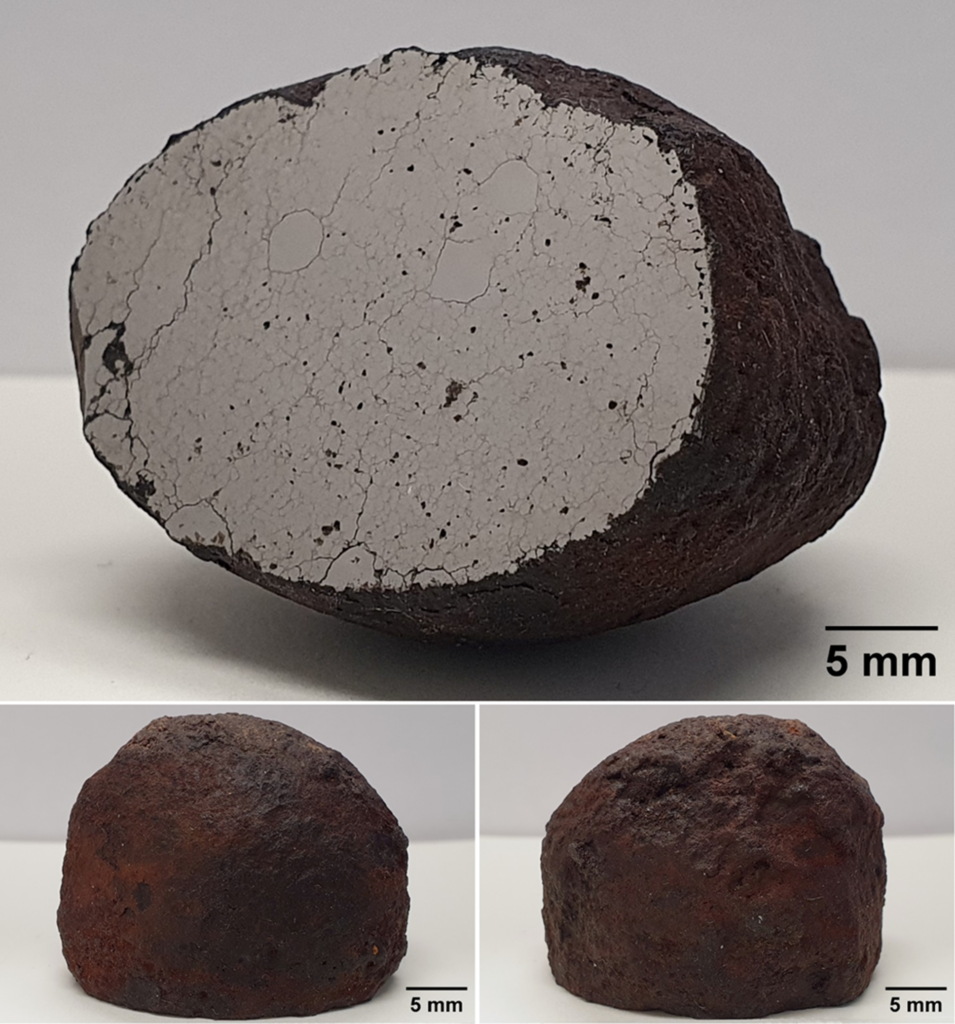
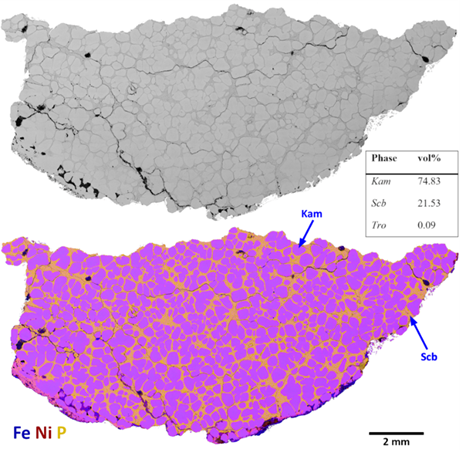
The research group analysed Löpönvaara and found that it is primarily composed of two rare iron-bearing minerals: kamacite and schreibersite. Kamacite consists of iron and nickel and forms crystalline structures, while schreibersite is a phosphide, containing phosphorus along with iron and nickel.
“Only seven other phosphorus-rich iron meteorites are known worldwide, and Löpönvaara is currently the richest in phosphorus among them. In addition, Löpönvaara’s unique structure and trace element composition make it a particularly intriguing discovery,” says Kotomaa.
Löpönvaara’s unusual composition suggests that the original asteroid’s core was divided into two distinct layers. At the same time, the meteorite’s structure bears evidence of a past collision.
Like Löpönvaara, the Lieksa pallasite is remarkable in its own right. Both Lieksa and Löpönvaara are classified as “ungrouped,” meaning their compositions differ significantly from other known iron meteorites and pallasites and cannot be placed into existing subgroups of iron meteorites and pallasites.
“The Lieksa pallasite appears to come from a parent body previously unknown from other meteorite discoveries. However, the parent bodies of other meteorites from Lieksa, including Löpönvaara, remain unknown and are currently under investigation at the Department of Geology and Mineralogy at Åbo Akademi University” Kotomaa explains.
The discovery of several small iron-rich meteorites in Lieksa suggests that they may all originate from the same source—a rare and complex celestial body with a unique composition and structure.
You can read the article on the classification of the Löpönvaara iron meteorite here: https://doi.org/10.1111/maps.70049
Enquiries:
Laura Kotomaa, doctoral student in geology and mineralogy at Åbo Akademi University
Email: laura.kotomaa@abo.fi
Telephone: +358 405 828 302

You might also be interested to read
-

Technology meets sustainability – Cataldo’s research seeks the optimal for each energy process
How can today’s energy needs be met by using sustainable alternatives, and how can this be done efficiently? These are questions that Cataldo De Blasio…

-
Why do we continue to buy fast fashion and make unsustainable consumption choices even when we know better?
Fast fashion and growing consumption are depleting natural resources and negatively impacting the world around us. Yet we keep shopping. Why? We asked Ilia Gugenishvili,…
-
Natural stone has left its mark on Turku
Natural stone as a building material is beautiful, versatile, reusable and has an almost eternal durability. Natural stone has been used for various types of…