

News


National CCU Forum: Finland needs a coordinated Carbon Capture and Utilisation ecosystem
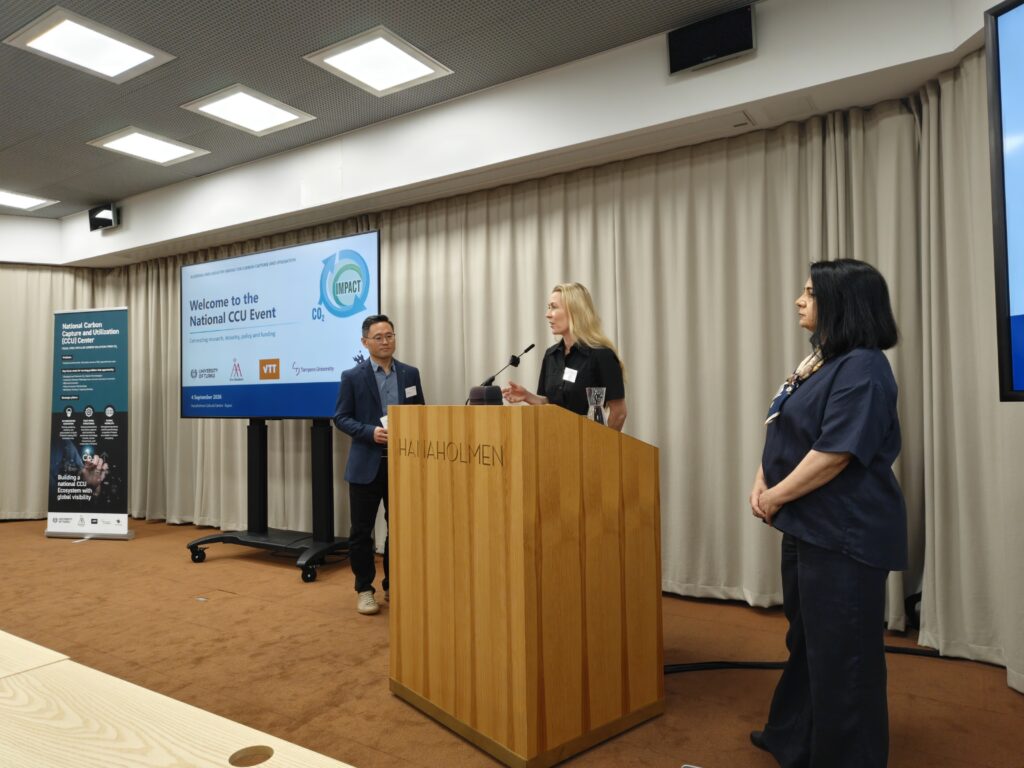
A national forum held at Hanaholmen in Espoo on 4 September brought together researchers, industry representatives, policymakers and other stakeholders to discuss how Finland can transform captured carbon into a valuable resource, and accelerate the wider deployment of carbon capture and utilisation.
Carbon capture and utilisation (CCU) is a key pillar of Europe’s transition towards a circular carbon economy and climate change mitigation.
Carbon dioxide (CO₂) is a greenhouse emission that must be reduced, but captured CO2 can also serve as a valuable resource. It can be turned into chemicals, durable materials, food, feed and fuel.
The National CCU Forum on 4 September provided a platform for all stakeholders to discuss the latest research, industrial applications and policy developments in the field. The forum was organised by Yagut Allahverdiyeva-Rinne (University of Turku) and Chunlin Xu (Åbo Akademi University), in collaboration with researchers from VTT Technical Research Centre of Finland, the University of Helsinki and Tampere University.
The discussions highlighted a key message: Finland needs stronger national coordination to turn its scientific expertise and substantial biogenic CO₂ resources into industrial opportunities.
From individual technologies to an integrated ecosystem
15 speakers from research, industry, government and the public sector took part, highlighting the breadth of CCU technologies already under development in Finland – and the need for closer collaboration across disciplines and sectors to bring these innovations together.
“Denmark operates a national CO₂ research centre, CORC, with €85 million in funding, while Sweden established a national CCUS centre this year. Finland brings to the table about 30Mt biogenic CO₂ annually but lacks a coordinated national effort,” noted Yagut Allahverdiyeva-Rinne from the University of Turku.
“We have a strong research field for turning waste CO2 from problem into a solution. Now is the time to unite academia and industry to do it,” said Chunlin Xu from Åbo Akademi University.
The case for integration was echoed from a European perspective. Joanna Kargul from the EU SUN2X-SET initiative called for a shift away from funding isolated technologies and towards building an integrated industrial carbon management system.
Antti Arasto of the Finnish Climate Change Panel highlighted the economic potential of using biogenic CO₂, estimating that utilising 20 per cent of Finland’s potential could generate an additional €3–5 billion annually for the Finnish economy.
Ulla Palander from the Ministry of Economic Affairs and Employment stressed that the technology alone isn’t enough: “Investors do not invest because technologies exist. They invest because markets exist.”
The CO2-IMPACT vision presented at the forum reflects this approach, aiming to integrate biological and chemical CO2 conversion processes to transform waste carbon into wide range of products – including pharmaceutical, fine chemicals, food, feed, fuels, and durable materials – positioning Finland as a European leader in circular carbon.
Research highlights from the University of Turku (Yagut Allahverdiyeva-Rinne), Åbo Akademi University (Chunlin Xu), VTT (Yvonne Nygård and Juha Lehtonen), Tampere University (Marika Kokko), and the University of Helsinki (Timo Repo) demonstrated just how diverse and fast-moving Finland’s CCU landscape already is.
Finland already has the needed expertise
Industry examples showed how this potential could translate into practice. Metsä Group generates approximately 12 million tonnes of biogenic CO₂ annually.
Minna Mentzer from Metsä Spring described a six-month pilot in Rauma, carried out with Andritz, which found no major obstacles to scaling the approach towards commercial deployment. Further examples were presented by Solar Foods (Juha-Pekka Pitkänen), Liquid Sun (Pasi Keinänen) and Vantaan Energia (Angela Juslin), further demonstrating the breadth of CCU applications now approaching commercial reality in Finland.
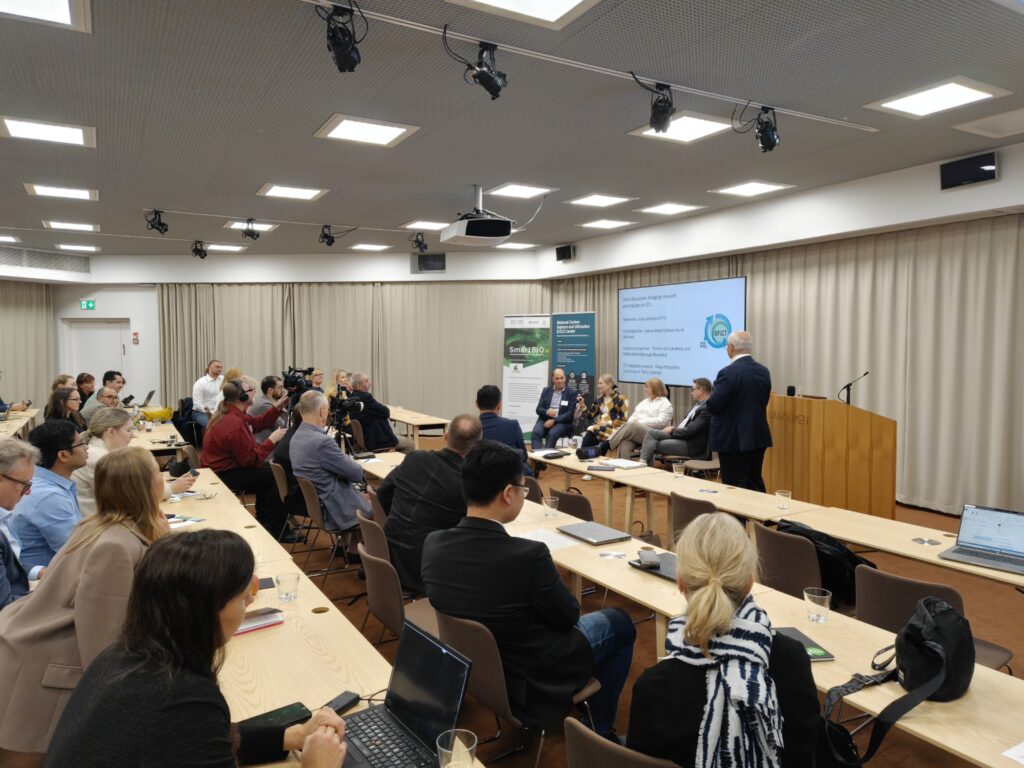
The event closed with a panel discussion, moderated by Juha Lehtonen, involving Mikko Rönkä (Borouge), Maija Pohjakallio (University of Turku and Metsä), Joanna Kargul (EU SunX2-SET and Warsaw University) and Thomas Kohl (Andritz). Panellists discussed the European and national perspectives and CCU regulatory aspects.
The forum’s purpose went beyond showcasing individual projects. It sought to strengthen connections among Finnish actors and link national activities with wider European initiatives.
“Finland already has expertise in biotechnology, chemistry, catalysis, carbon capture, energy systems, industrial processes, and circular economy solutions. Combining these capabilities could generate new value chains in which captured carbon is used as a feedstock by multiple sectors,” emphasises Allahverdiyeva-Rinne.

You might also be interested in
-
V-FOREST: turning damaged forest biomass into bio-based cosmetic ingredients
The V-FOREST project addresses the urgent need for innovative, sustainable and economically viable valorisation processes for damaged and underutilised forest biomass.

-
Global leader in sustainable bioproducts highlights Åbo Akademi University’s role in the bioeconomy transition
Åbo Akademi University recently welcomed Arthur J. Ragauskas, Professor and Governor’s Chair in Biorefining at the University of Tennessee and one of the world’s most influential researchers in renewable…
-
Åbo Akademi University awarded more than EUR 3 million for research into sustainable materials of the future
Åbo Akademi University has been awarded just over EUR 3 million in funding from Business Finland to take part in an international research collaboration on…