


News


Five questions for Dr. Wang on her work with sustainable biomaterials
Dr. Xiaoju Wang is a materials scientist working at Åbo Akademi University, where she leads a research group focusing on sustainable biomaterials. Her research explores how natural components from wood, such as cellulose, hemicellulose, and lignin, can be transformed into advanced materials for applications in healthcare and other sustainable technologies.
What sparked your interest in your field?
My interest in this field began during my master’s studies in colloid and interface chemistry at Shandong University in China. At that time, I became fascinated by how polymeric materials can be engineered at the microscopic and nanoscopic levels to create entirely new functions and properties. Over the years, that curiosity has developed into a passion for creating sustainable materials from renewable natural resources.
What motivates me most today is the opportunity to contribute to solutions for major global challenges, including sustainability, resource efficiency, and human health. Åbo Akademi University provides a unique environment for this work, with internationally recognized expertise in wood-based biopolymers and biorefinery technologies. I see my role as bridging fundamental research in biopolymer chemistry and nanotechnology with the development of innovative biomaterials that can make a real difference to society.
What is the most unexpected discovery you have made in your research, and why did it turn out to be significant?
One of the most unexpected discoveries in my research came from studying xylan, a natural polymer found in wood and other plant materials. By removing the side units and functional groups from the xylan structure, we created a more linear version of the molecule. To our surprise, these modified xylan chains spontaneously organized themselves into tiny cubic crystals through hydrogen bonding. Intrigued by this behaviour, I began to investigate the spatial conformation of this linear pentose-based polymer in greater detail. Then I come to recognize the subtle but potentially important differences between engineered xylan and cellulose, the more widely studied linear polysaccharide composed of hexose units.
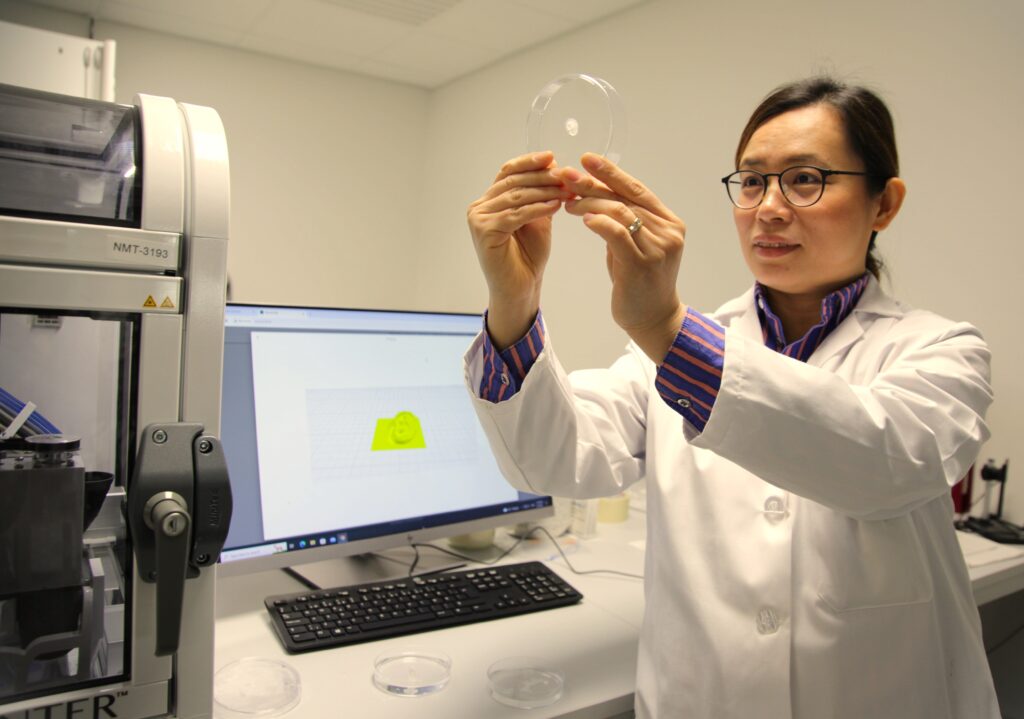
Photo: Åbo Akademis bildbank
These findings inspired the scientific hypothesis behind the Academy Project XylBBP (Xylan Bottlebrush Polymers), which aims to use the engineered xylan as a building block for advanced nanoscale materials. I believe that xylan, often considered the lesser-known relative of cellulose, may possess unique structural features that can be harnessed to create entirely new classes of sustainable biomaterials. .
What are the biggest challenges researchers in your field face today?
Whether in healthcare, energy technologies, or consumer products, we need materials that are both high-performing and environmentally responsible. I believe one of the greatest challenges facing researchers today is how to create sustainable materials that can replace fossil-based products while still delivering the advanced functionality that modern society requires.
We have a growing understanding of how natural materials from wood, such as cellulose, hemicellulose, and lignin, can be transformed into advanced functional materials. However, translating laboratory discoveries into products that can be manufactured and used in healthcare, industry, or everyday life remains a complex task.
Photo: Bettina Rehnström
How do you think, or hope, your research may influence society?
Looking ahead 10 years, I hope my research will contribute to the development of more sustainable and bio-based healthcare technologies. For example, XylBBP project explores the use of biomass-derived xylan from forest resources as a building block for advanced bottlebrush polymers and unimolecular nanomaterials.
Our goal is to develop novel therapeutic platforms for combating bacterial infections, particularly those associated with antimicrobial resistance. More broadly, I see great potential in combining renewable biopolymers with advanced manufacturing technologies for applications such as drug delivery, antimicrobial materials, and tissue engineering.
By integrating sustainable materials science with biomedical innovation, I hope to create solutions that improve human health while supporting a more sustainable future.
If you hadn’t become a researcher, what profession would you have chosen?
To be honest, I have never seriously considered a career outside research. From an early stage, I was drawn to the process of discovery and the opportunity to create new knowledge. However, if I had chosen a different path, I would likely have become an innovator working at the interface of science and industry.
What has always motivated me is the possibility of transforming scientific knowledge into practical solutions that address real-world challenges and create tangible societal impact.
The answers are written by dr. Wang and edited by Catrin Sandvik, ÅAU
